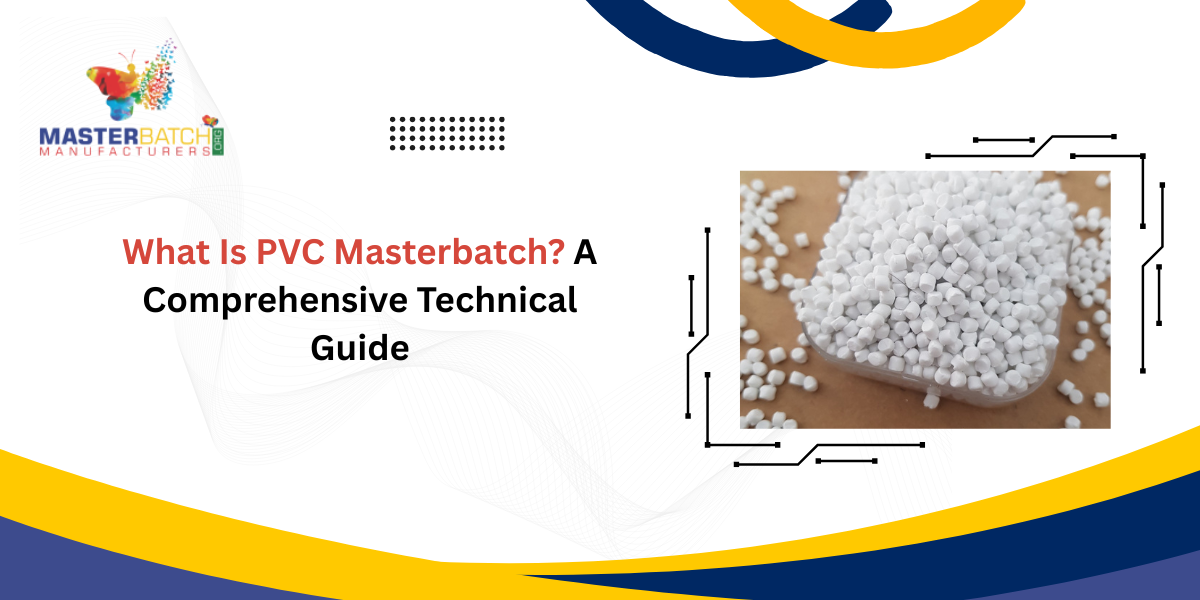

PVC masterbatch is a concentrated blend of pigments, stabilizers, fillers, and additives carried inside a PVC-compatible base resin. Manufacturers add it during processing to give PVC products their final color, stability, and performance properties – all in one precise, easy-to-handle pellet.
Sunil runs a PVC pipe fitting unit in Ahmedabad. For years, he mixed raw pigment powder directly into his compound. Color was never consistent – some batches ran too dark, others looked faded after three months. A distributor suggested switching to PVC masterbatch. Within two weeks, his rejection rate dropped by half, and his color matching stopped being a daily problem.
What Exactly Is PVC Masterbatch and What Does It Contain?
PVC masterbatch is a ready-to-use additive system where color pigments and functional chemicals are pre-dispersed in a PVC carrier at high concentration. It removes the guesswork from manual compounding on the production floor.
A standard PVC masterbatch pellet carries more than just pigment. It holds a full system of ingredients that work together during processing.
Typical contents inside a PVC Colour masterbatch formulation:
- Pigments or dyes – for color
- Heat stabilizers – to prevent PVC degradation during melting
- Lubricants – internal and external, for smooth flow and mold release
- Fillers like calcium carbonate – for cost reduction and rigidity
- Impact modifiers – to improve toughness in rigid PVC products
- UV stabilizers – for outdoor-use grades
How Does PVC Masterbatch Work During Processing?
PVC masterbatch disperses evenly into the PVC compound during melt processing at temperatures between 160°C and 200°C. The carrier resin melts with the base PVC, releasing pigment and additives uniformly throughout the melt.
This even dispersion is the key advantage. Raw pigment powder does not mix this cleanly – it can streak, clump, or settle unevenly in the barrel. PVC masterbatch eliminates all of that.
The result is a finished product – pipe, profile, film, or cable sheathing – with the same color and property consistency from the first piece to the last piece of the shift.
What Are the Main Types of PVC Masterbatch Available?
PVC masterbatch comes in color, filler, stabilizer, and functional grades – each designed for a specific processing need. Most processors use a combination depending on the application.
|
Type |
Primary Function |
Common Application |
|
Color PVC Masterbatch |
Pigment delivery and color matching |
Pipes, profiles, films, footwear |
|
Filler PVC Masterbatch |
Cost reduction with CaCO3 loading |
Rigid pipes, sheets, cable ducts |
|
Stabilizer PVC Masterbatch |
Thermal protection during processing |
All PVC processing applications |
|
UV-Resistant PVC Masterbatch |
Outdoor durability and color retention |
Window profiles, garden pipes |
|
Flame Retardant PVC Masterbatch |
Fire resistance compliance |
Wire and cable insulation |
Choosing the wrong type is the most common mistake processors make when they first switch to PVC masterbatch. A pipe-grade filler masterbatch will not perform in flexible PVC cable sheathing – the formulations are fundamentally different.
Where Is PVC Masterbatch Used Across Indian Industries?
PVC masterbatch is used in pipe manufacturing, cable insulation, window profiles, flexible sheets, footwear soles, flooring, and medical tubing. The construction and electrical sectors in India consume the largest volumes.
In cities like Ahmedabad, Pune, and Delhi NCR, PVC pipe and fitting units run PVC masterbatch on every shift. Building material suppliers demand consistent grey, white, or blue pipe colors that match IS standards – and only PVC masterbatch delivers that batch after batch.
Sectors where PVC masterbatch runs regularly in India:
- CPVC and UPVC pipe manufacturing
- Electrical wire and cable sheathing
- Rigid PVC window and door profiles
- PVC flooring, wallcovering, and decorative sheets
- Footwear and sandal soles
- Medical-grade flexible tubing
- Automotive interior trims and seals
How Is PVC Masterbatch Different From a Pre-Mixed PVC Compound?
PVC masterbatch is a concentrated additive that you blend into plain PVC resin yourself. A pre-mixed PVC compound arrives already fully formulated and ready to process directly. Both serve different production setups.
Processors with flexible production lines prefer PVC masterbatch because it lets them adjust color and filler loading without sourcing a new compound grade for every product change. A pre-mixed compound is rigid – what you buy is what you process.
|
Factor |
PVC Masterbatch |
Pre-Mixed PVC Compound |
|
Flexibility |
High – adjust ratios per product |
Low – fixed formulation |
|
Storage |
Multiple masterbatch types needed |
Single bag, simpler storage |
|
Cost per kg |
Lower additive cost |
Higher, all-in price |
|
Skill required |
Needs correct dosing knowledge |
Minimal – ready to run |
|
Color change speed |
Fast – just switch masterbatch |
Slow – full purge needed |
Small-batch and custom-color processors in Rajasthan and Gujarat tend to prefer PVC masterbatch for exactly this flexibility.
What Should You Check Before Buying PVC Masterbatch?
Before buying PVC masterbatch, confirm the heat stabilizer system, the recommended loading ratio, and whether the grade is meant for rigid or flexible PVC. These three points decide whether the masterbatch performs or causes problems.
Lead-based stabilizer systems are still available but face increasing restriction under RoHS and export compliance rules. If your product goes to Europe or any RoHS-sensitive market, you need a calcium-zinc or tin-based PVC masterbatch grade from the start.
Things to confirm with your supplier before the first trial:
- Stabilizer type – lead-free, calcium-zinc, or tin-based
- Compatible PVC K-value range
- Recommended addition rate for your application
- Processing temperature window
- Whether the grade is for rigid or flexible PVC
- Any relevant certifications – RoHS, REACH, food-contact, or IS standards
Suppliers listed on masterbatchmanufacturers.com typically provide trial packs and full technical data sheets before you commit to a bulk order, which matters a lot when you are switching grades.
FAQ: PVC Masterbatch
Q1. What is the standard addition rate for PVC masterbatch in pipe manufacturing?
Filler grades typically run at 10%–30% loading. Color PVC masterbatch is usually added at 2%–5%, depending on the shade and opacity needed.
Q2. Can PVC masterbatch replace a full PVC compound?
No. PVC masterbatch is an additive – it still needs a base PVC resin to function. It does not replace a fully formulated compound.
Q3. Is lead-free PVC masterbatch available in India?
Yes. Calcium-zinc-stabilized and tin-based PVC masterbatch grades are available from most reputable domestic suppliers.
Q4. Why does my PVC product turn yellow after processing?
Insufficient heat stabilizer in the PVC masterbatch or processing above the recommended temperature are the most common causes. Review the stabilizer loading and barrel temperature settings.
Q5. Can the same PVC masterbatch work for both rigid and flexible PVC?
Generally not. Rigid and flexible PVC have different stabilizer and lubricant needs. Always use a grade formulated specifically for your application type.
Follow us on Instagram for PVC Color Concentrate updates, processing tips, product insights, and plastic industry trends.