
Walk into any field in Rajasthan or Gujarat in peak summer. You will find black irrigation pipes running across the ground, sitting under direct sun for hours every single day. Those pipes do not crack. They do not fade. They just work, season after season because manufacturers use black masterbatch for UV stabilization during production.
Now think about a cheap plastic stool left on a terrace. One summer and it is already chalky. Two summers and pieces start breaking off.
Same sun. Very different results. The reason those pipes survive, and the stool does not, comes down to one thing added during manufacturing – black masterbatch for UV stabilization.
How Black Masterbatch for UV Stabilization Prevents Sun Damage
UV radiation from sunlight does not just fade colours. It breaks down the actual structure of plastic at a molecular level. The technical name for this is photodegradation, but on the production floor people just call it UV damage or weathering.
What this looks like on a product over a few months of outdoor use –
- Surface starts turning white or chalky even if the product was originally dark coloured
- Small cracks appear first on the surface, then go deeper
- The plastic loses its flexibility and becomes brittle
- Load-bearing capacity drops and the product fails earlier than it should
For a garden chair this is annoying. For an agricultural pipe carrying water across a 10-acre field, or a cable jacket running along a highway, early failure is a serious and expensive problem.
How Carbon Black in UV Stabilization Masterbatch Protects Plastic
Carbon black is a very fine black powder. It comes from burning petroleum products in a controlled, low-oxygen environment. It has been mixed into rubber and plastic for decades, and the reason it keeps getting used is simple – nothing beats it for UV absorption at the cost it comes at.
When carbon black particles are spread evenly through a plastic product, they sit throughout the material like a dense network of tiny shields. UV radiation coming from sunlight hits these particles before it can reach the polymer chains underneath. The particles absorb that UV energy and release it as a small amount of heat instead.
That heat dissipates without causing any harm. The polymer chains stay intact. The product holds its strength and structure for much longer.
Carbon black does not reflect UV away. It absorbs the energy completely and converts it – the polymer underneath never gets hit.
Particle size matters here too. Finer carbon black particles cover more surface area inside the plastic for the same weight. More surface area means more UV gets absorbed before reaching the polymer. Quality suppliers always mention average particle size along with the carbon black percentage – both numbers tell you about real-world protection performance.
Many manufacturers combine UV Masterbatch with carbon black to improve outdoor durability and weather resistance in plastic products.
Why Not Just Throw Raw Carbon Black Powder into the Mixer
Some smaller operations try this. It creates a mess and the results are inconsistent.
Raw carbon black powder is extremely fine – finer than most industrial powders. It floats into the air, coats everything around it, and getting it to mix evenly through a plastic melt without specialised equipment is very difficult. Uneven mixing means some parts of the product have too much carbon black and some parts have almost none. The UV protection becomes patchy and unreliable.
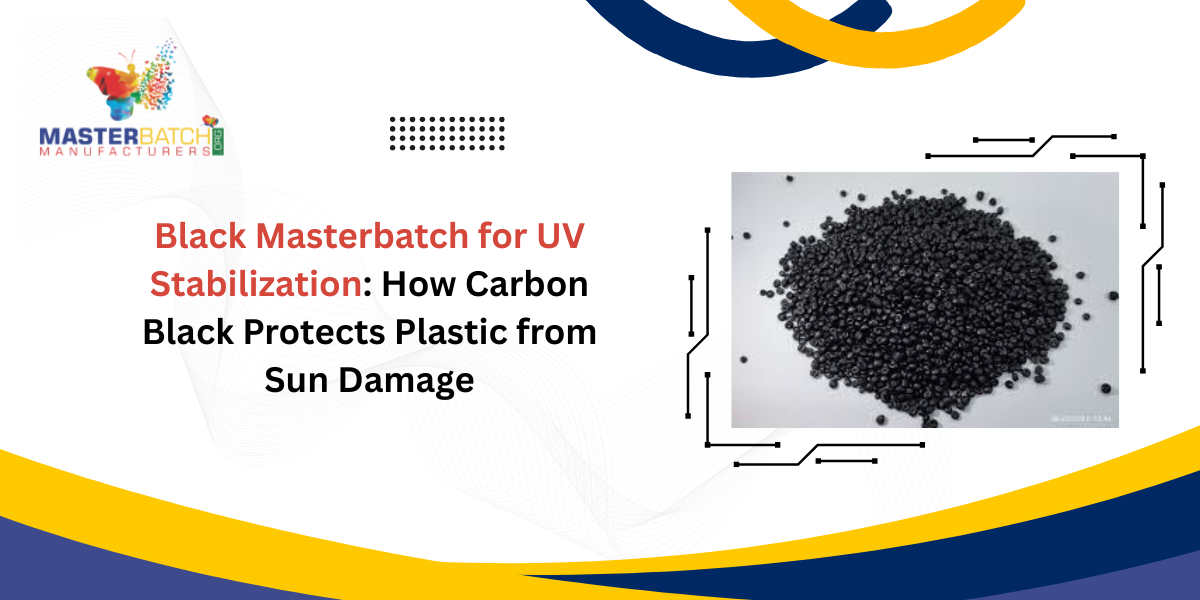
Black masterbatch for UV stabilization was developed specifically to solve this. The carbon black is already pre-dispersed into a carrier resin that is compatible with the base plastic being processed. It comes out as clean, handleable pellets. You add pellets to your hopper alongside the base resin, and the mixing during processing gives you an even, consistent distribution every time.
- No dust, no contamination in the production area
- Carbon black spreads evenly through the entire product
- Dosing is accurate and repeatable from batch to batch
- Machinery stays cleaner and maintenance intervals are longer
For any product where consistent UV protection across every metre or every unit matters, masterbatch is the only practical option.
Advanced Additive Masterbatch solutions help enhance UV stability, processing performance, and long-term product strength.
How Much Carbon Black Actually Goes Into the Product
Around 2 to 2.5 percent carbon black by weight in the finished product is where most outdoor plastic applications land. That is the loading that gives reliable long-term UV protection without unnecessary cost addition.
Black masterbatch for UV stabilization typically contains 40 to 50 percent carbon black by weight in the carrier. So to hit 2 percent carbon black in the final product, you add roughly 4 to 5 percent masterbatch to the base resin. The exact number depends on the masterbatch grade and the application requirements.
Going below 1.5 percent carbon black in the final product generally gives weaker protection. Going well above 3 percent does not proportionally improve performance and adds cost. Most manufacturers work within the 2 to 2.5 percent range and it holds up well across applications.
Leading Colour masterbatch manufacturers now develop outdoor-grade formulations designed to resist fading under harsh sunlight.
Products That Depend on This Every Day
Black masterbatch for UV stabilization goes into a wider range of products than most people realise.
- Agriculture and drip irrigation pipes sitting in open fields across seasons
- Power and telecom cable outer jackets running outdoors for decades
- Overhead water storage tanks on rooftops are baking under the daily sun
- Greenhouse films and mulch films are used across farming regions
- Geomembranes used in canals, ponds, and construction sites
- Automotive plastic parts on the exterior or underbody of vehicles
All of these products need to hold up for years outdoors. Carbon Black Masterbatch is what makes that possible without switching to more expensive engineering plastics or adding thick UV-absorbing coatings on the surface.
One Thing Worth Knowing Before You Buy
Not all black masterbatch for UV stabilization performs the same. Two masterbatches can both say 40 percent carbon black on the datasheet, but have very different UV protection performance based on the particle size and dispersion quality of the carbon black used.
Always ask for dispersion quality data and ideally run an accelerated weathering test on sample products before committing to a large production run with a new masterbatch supplier. A few days of testing saves months of field complaints later.
High-performance engineering masterbatch is commonly used in automotive and industrial applications exposed to continuous UV exposure.
FAQs on Black Masterbatch for UV Stabilization
Q1. What is black masterbatch for UV stabilization?
It is carbon black pre-mixed into a carrier resin and supplied as pellets. You add it to your base plastic during processing, and it gives the finished product protection against UV radiation from sunlight.
Q2. How does carbon black protect plastic from UV damage?
Carbon black particles absorb UV radiation before it reaches the polymer chains inside the plastic. The absorbed energy converts to a tiny amount of heat and dissipates. The polymer underneath stays undamaged for much longer.
Q3. What percentage of black masterbatch should I add?
For most outdoor applications, 4 to 5 percent masterbatch addition gives you around 2 percent carbon black in the final product, which is the standard target for good UV protection. Confirm with your supplier for your specific grade.
Q4. Can I use raw carbon black instead of masterbatch?
Technically, yes, but practically it is a bad idea. Raw powder creates dust, mixes unevenly, and contaminates your production area. Masterbatch gives consistent dispersion and is much cleaner to handle.
Q5. Does carbon black loading affect other plastic properties?
At normal loading levels of 4 to 5 percent masterbatch, the effect on mechanical properties is very small. Tensile strength sometimes improves slightly. Only overdosing causes issues, so stay within the recommended range.
Follow us on Instagram for more updates on types of masterbatch, plastic manufacturing tips, and ways to improve product quality and efficiency.