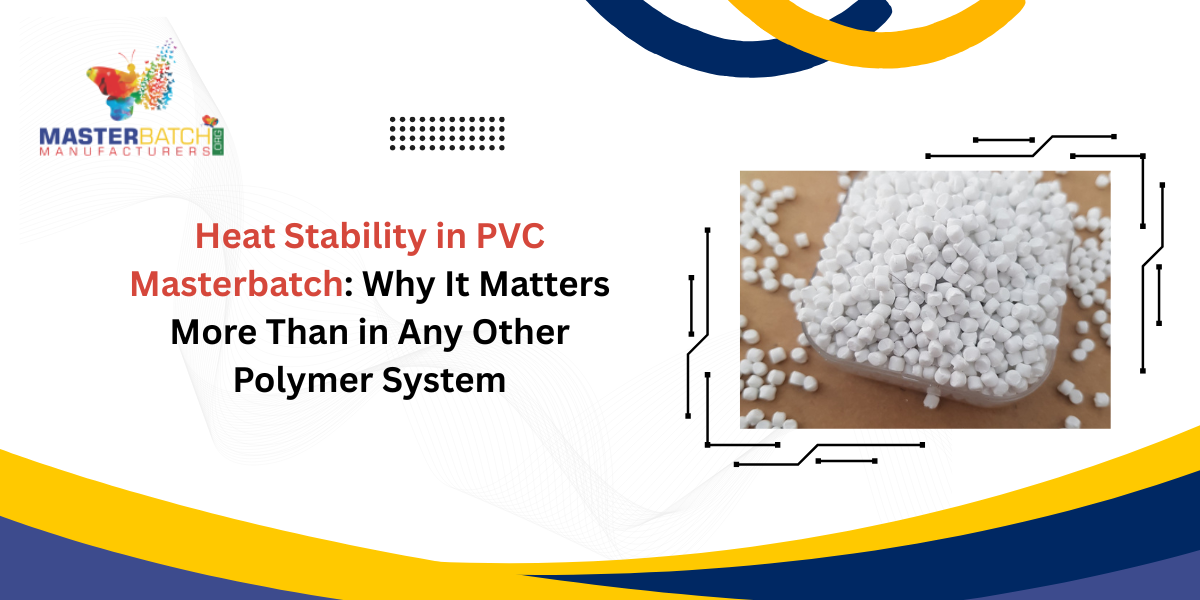

Heat stability in PVC masterbatch is one of the most important factors in successful PVC processing because PVC is a difficult polymer to work with. Anyone who has spent time around PVC processing knows this. The material gives you good mechanical properties, decent chemical resistance, and a wide range of applications. But it punishes you fast if you do not manage the processing conditions properly. Most polymers tolerate a bit of extra heat during processing. PVC does not. Push the temperature slightly above where it should be, and the degradation starts almost immediately. The color shifts. Hydrogen chloride gas releases. The material starts breaking down from the inside.
This is why heat stability in PVC masterbatch is not just a technical checkbox. It is one of the most critical factors in the entire formulation, and nobody should be treating it lightly.
Why Heat Stability in PVC Masterbatch Degrades So Differently From Other Polymers
To understand why heat stability in PVC masterbatch matters so much, you need to understand what happens to PVC when it overheats.
PVC starts degrading at temperatures around 140 degrees Celsius. That is not very high. Most other polymers process comfortably above 200 degrees without serious degradation concerns. PVC processing temperatures typically fall between 160 and 200 degrees, which means the margin between safe processing and degradation is very narrow.
When PVC degrades, it releases hydrogen chloride gas. That gas is corrosive, toxic, and it accelerates further degradation in a chain reaction. The more HCl that is released, the faster the remaining material degrades. This is called autocatalytic degradation and it is what makes PVC uniquely challenging compared to polyethylene, polypropylene, or any other common polymer.
The visible sign is a color change. Undegraded PVC is clear or white. Early degradation turns it yellow. Further degradation turns it orange, then brown, then black. By the time you see black, the material has serious structural damage and is unusable.
Many manufacturers rely on Additive Masterbatch solutions to improve thermal stability and processing efficiency in plastic compounds.
What Heat Stability in PVC Masterbatch Actually Means
When someone talks about heat stability in PVC masterbatch, they are talking about how well the masterbatch formulation protects the PVC from this degradation during processing.
A properly stabilized PVC masterbatch contains heat stabilizer systems that do two things:
- They neutralize the hydrogen chloride as it is released, stopping the autocatalytic chain reaction before it accelerates
- They replace labile chlorine atoms in the PVC chain that are the starting points for degradation, slowing down the initial release
The stabilizer system is not an afterthought in the masterbatch formulation. It is often the most important ingredient after the PVC resin itself. Getting the stabilizer type and loading wrong means the masterbatch degrades before it even does its intended job of adding color or functional properties to the compound.
Reliable Color Masterbatch grades ensure uniform colour dispersion and better performance during high-temperature processing.
Types of Heat Stabilizers Used
Different stabilizer systems suit different PVC applications. Understanding which one your masterbatch uses tells you a lot about what applications it is suitable for.
Lead-based stabilizers were the traditional choice for decades. Excellent heat stability, good electrical properties, cost effective. However, lead is now heavily restricted or banned in most markets due to toxicity concerns. You will still encounter them in some industrial applications, but they are being phased out rapidly.
Calcium zinc stabilizers are the most widely used replacement. They work well across a broad range of PVC applications, are non-toxic, and comply with food contact and RoHS regulations. The performance does not quite match lead-based systems, but formulation improvements have closed that gap significantly in recent years.
Organotin stabilizers give very high heat stability and excellent clarity in transparent PVC applications. They are common in rigid PVC profiles, pipes, and bottles, where clarity and long processing times matter. The cost is higher than calcium zinc systems.
Barium zinc stabilizers offer a middle ground between performance and cost. Common in flexible PVC applications like cables, flooring, and artificial leather, where extended heat stability during processing is needed.
The stabilizer system in a PVC masterbatch determines its processing window, its suitability for food or medical contact applications, and its compliance with regional regulations. These are not small details.
Where Poor Heat Stability Shows Up in Production
Heat stability in PVC masterbatch failures does not always announce itself dramatically. Sometimes the signs are subtle, and production teams miss them until the problem is already out of control.
Watch for these signs that heat stability is not where it should be:
- Color shift in the finished product, even when processing temperatures look normal
- Yellow or brown streaks running through the product in the direction of flow
- Surface discoloration that gets worse the longer the machine runs without purging
- Buildup of degraded material inside the die or on the screw that contaminates subsequent output
- Smell of hydrogen chloride — sharp, acrid smell near the machine during processing
- Mould or die corrosion over time from repeated HCl exposure
Any one of these is worth investigating immediately. All of them together mean the heat stability system in the masterbatch is seriously inadequate for the processing conditions being used.
Premium PPA Masterbatch grades help improve melt flow and reduce processing defects during extrusion operations.
Processing Conditions That Affect Heat Stability
Even a well-formulated masterbatch with good heat stability will struggle if the processing conditions are not managed properly. PVC demands attention to conditions that other polymers would shrug off.
Residence time in the barrel is a big one. The longer PVC sits in a hot barrel, the more heat history it accumulates. Slow production, machine stoppages, and oversized barrels for the output rate all increase residence time and put more stress on the stabilizer system.
Shear heat is another factor. High screw speeds generate shear heat that adds to the barrel temperature and can push PVC past its stability limit even when the barrel set points look fine. Processing PVC at lower screw speeds with correct barrel temperatures is generally a better practice than running fast with lower barrel settings.
Contamination in the compound also affects stability. Traces of moisture, acidic impurities from recycled material, or incompatible additives can all interact with the PVC or the stabilizer system and reduce the effective processing window.
Why This Is More Critical in PVC Than Any Other System
Other polymers have heat stability considerations too. Polyethylene degrades at very high temperatures. Nylon absorbs moisture and needs drying. Polycarbonate is sensitive to processing conditions.
But none of them have the same narrow processing window, the same autocatalytic degradation mechanism, and the same combination of toxic gas release and rapid visual degradation that PVC has. The consequences of getting heat stability wrong in PVC are faster, more visible, and more serious than in any comparable polymer system.
A masterbatch with good heat stability in PVC processing keeps the window open wide enough to handle normal process variations without degradation starting. A poorly stabilized one leaves almost no margin and any small deviation triggers a cascade that is hard to stop once it begins.
Advanced engineering masterbatch solutions are widely used in technical applications requiring heat and chemical resistance.
Quick Summary of Heat Stability in PVC Masterbatch
Heat stability in PVC masterbatch matters more than in any other polymer system because PVC degrades rapidly, releases corrosive gas, and does so in a self-accelerating reaction that is hard to reverse once it starts.
The stabilizer system inside the masterbatch is what keeps this under control. Match the stabilizer type to your application, manage your processing conditions, and watch for early signs of degradation before they become serious production problems.
Get heat stability right in PVC, and everything else becomes manageable. Get it wrong and the problems come fast, and they come together.
High-performance pvc masterbatch helps improve processing stability and colour consistency in rigid and flexible PVC applications.
FAQs of Heat Stability in PVC Masterbatch
Q1. Why does PVC need heat stabilizers more than other plastics?
PVC starts degrading at relatively low temperatures and releases corrosive HCl gas that accelerates further breakdown. Other polymers do not have this same chain reaction mechanism.
Q2. What is the most common stabilizer used in PVC masterbatch today?
Calcium zinc stabilizers are the most widely used now. They replaced lead based systems and work well across most PVC applications without toxicity concerns.
Q3. How do I know if my PVC masterbatch has poor heat stability?
Yellow or brown streaks, color shift during long runs, acrid smell near the machine, and die buildup are the most common signs that heat stability is insufficient.
Q4. Does processing temperature alone determine heat stability performance?
No. Residence time in the barrel, shear heat from screw speed, and contamination in the compound all affect how much stress the stabilizer system faces during processing.
Q5. Can I use a standard color masterbatch in PVC processing?
Not safely. Standard masterbatches are not formulated for PVC’s narrow processing window. You need a masterbatch specifically designed with a PVC-compatible stabilizer system.
Follow us on Instagram for more updates on types of masterbatch, plastic manufacturing tips, and ways to improve product quality and efficiency.