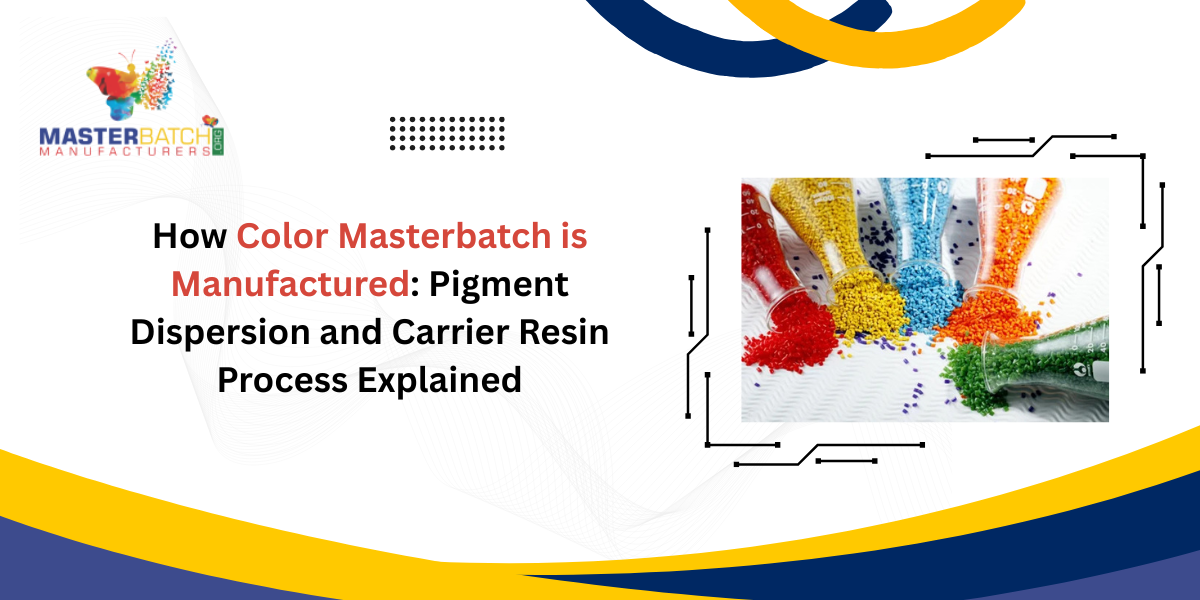

Someone on your production floor drops color masterbatch pellets into the hopper, and the machine runs. Output comes out colored. Nobody questions it. But when streaks show up, shade varies across a run, or specks appear on the surface -suddenly everyone wants answers, and nobody knows where to look.
Understanding how color masterbatch gets made solves that problem fast. Here is the full picture without the chemistry lecture.
What the Color Masterbatch Actually Is
Color masterbatch is not just colored plastic. It is a very high concentration of pigment locked inside a carrier resin, processed into small pellets. The pigment load can go from thirty to seventy percent by weight, depending on the grade.
When those pellets enter your machine and mix with your base polymer, the pigment is supposed to spread evenly and color the final product uniformly. That even spread is called dispersion. The entire manufacturing process exists to achieve good dispersion. Get it right, and the masterbatch performs consistently. Get it wrong, and no machine setting on your end will fully fix the output.
Pigment Selection
The process starts with choosing the right pigment. Not every pigment behaves the same way inside a manufacturing process, and choosing the wrong one creates problems that follow the product all the way to the customer.
Pigments fall into two broad types:
- Organic pigments -vivid and bright, good where color intensity matters, but can be sensitive to high processing temperatures
- Inorganic pigments -more heat stable and durable, slightly less intense in shade, better for outdoor or high-temperature applications
Particle size within the pigment matters too. Finer particles disperse more easily and give a cleaner color. Coarser particles need more mechanical energy to break apart and are more likely to create specks if the process is not managed properly.
Advanced Additive Masterbatch solutions help improve processing stability and reduce defects during plastic manufacturing.
Carrier Resin Selection
The carrier resin is the polymer that holds the pigment in pellet form and delivers it into your production process. This is not a random choice, and picking the wrong carrier causes real problems.
The carrier must be compatible with the base polymer the customer runs. Incompatible combinations give poor mixing, surface haze in transparent products, and defects that no processing adjustment fixes.
Common carrier resins in color masterbatch production:
- Polyethylene -for PE films, bottles, and containers
- Polypropylene -for PP injection molding and woven products
- Polystyrene -for packaging trays and disposable items
- EVA or wax-based -for low-temperature or specialty applications
Universal carrier grades also exist and work across multiple polymer types. They suit distributors serving different industries, but a matched carrier always outperforms a universal one for any specific application.
Many Masterbatch manufacturers in India use twin screw extrusion technology for better dispersion and consistent product quality.
Pre-mixing
Before anything enters a machine, pigment powder and carrier resin go through a high-speed mixer. The mixer coats the pigment onto the surface of the carrier resin particles and creates a uniform dry blend.
This step does not achieve dispersion on its own. It just prepares the material so it feeds consistently into the extruder. Uneven pre-mix leads to uneven feeding, and uneven feeding shows up as color variation in the final product.
Dispersing agents or wetting additives sometimes go in at this stage, depending on what the pigment needs to break apart properly.
High-performance engineering masterbatch is widely used where heat resistance and dimensional stability are critical.
Twin Screw Extruder -Where Dispersion Happens
This is the stage that defines color masterbatch quality. Everything before this is preparation. The twin screw extruder is where actual dispersion occurs.
Two intermeshing screws rotate inside a heated barrel and pull material through different zones. Three things happen as the material moves through:
- Heat melts the carrier resin and softens the pigment clusters
- Mechanical shear from the screws physically breaks those clusters into finer particles
- Mixing sections distribute the fine particles evenly throughout the melt
Screw speed, barrel temperature at each zone, and screw design are all dialed in for each specific pigment and carrier combination. Too much heat damages heat-sensitive pigments. Too little shear and dispersion results in poor. There is a specific processing window, and experienced manufacturers know exactly where it is.
This is where cheap color masterbatch fails. A manufacturer cutting corners runs outside that window to save energy or time. The pellets look fine. The color looks correct. But dispersion is poor, and your production floor finds out the hard way when streaks appear mid-run.
Pelletizing and Cooling
After the extruder, molten colored material comes out through a die in thin continuous strands. Those strands go straight into a water bath or air cooling system to solidify.
A pelletizer then cuts the solid strands into small, uniform pellets. Size consistency matters more than it seems -uniform pellets feed evenly into the customer’s machine. Inconsistent sizes cause uneven dosing, which shows up as shade variation across a production run.
After pelletizing, the pellets go through a dryer to remove moisture picked up during cooling. Moisture left in the pellets causes bubbles and surface defects in the customer’s final product.
Manufacturers often combine pigments with UV Masterbatch for outdoor plastic products exposed to sunlight and weathering.
Quality Checks
A serious color masterbatch manufacturer verifies output at multiple points before anything gets packed:
- Color matching against the approved standard under controlled lighting
- Dispersion plaque test -thin pressed sample checked against light for specks
- Melt flow index check to confirm carrier resin integrity after extrusion
- Heat stability check for grades going into high-temperature processing
- Moisture content check on finished pellets
Any batch that does not pass goes back or gets rejected. This layer of verification is what separates a reliable supplier from one who is just shipping colored pellets and hoping they work.
Why This Matters When You Buy
When you understand how color masterbatch is manufactured, you stop buying only on price and color match. You start asking questions that actually reveal whether a supplier has a proper process.
Ask what carrier resin is used. Ask what the pigment load is. Ask how dispersion is tested and whether you can see the plaque result. These questions tell you very quickly whether the supplier knows what they are doing or not.
Premium Black Masterbatch grades are preferred in applications requiring strong opacity, UV protection, and smooth surface finish.
Quick Summary on Color Masterbatch
Color masterbatch manufacturing moves through pigment selection, carrier resin matching, pre-mixing, twin screw extrusion, pelletizing, and quality verification. Every step feeds into the next.
Dispersion is the whole game. A masterbatch that disperses well performs consistently run after run. One that disperses poorly causes problems that no machine adjustment on your end will fully solve. Know the process, and you always know where to look when something goes wrong.
Leading Colour masterbatch manufacturers focus on advanced extrusion techniques for accurate pigment dispersion.
FAQs on Color Masterbatch
Q1. What is color masterbatch made of?
Concentrated pigment dispersed inside a carrier resin, processed through an extruder and cut into small pellets for use in plastic production.
Q2. Why does carrier resin need to match my base polymer?
Incompatible combinations give poor mixing and cause defects like haze or streaks that no processing adjustment on your machine will fix.
Q3. What causes color specks in my final product?
Almost always poor dispersion during manufacturing. Pigment clusters were not broken down properly in the extruder and show up as specks in the output.
Q4. Can one color masterbatch grade work across different polymers?
Universal carrier grades exist for that but a matched carrier always performs better than a universal one for any specific polymer type.
Q5. How do I check dispersion quality before buying?
Ask for a dispersion plaque test result. A thin sample pressed and held against light clearly shows any undispersed pigment or specks in the batch.
Follow us on Instagram for more updates on types of masterbatch, plastic manufacturing tips, and ways to improve product quality and efficiency.